《收藏》2021年11月 · 石村块与《清明上河图》
2021年11月 ·《收藏》杂志
“石村块”艺术推动传统中国艺术在数字化时代复兴 — 石村版「清明上河图」被纽约工行收藏
艺术块艺术语言分析
作者:胡桃
1987年,石村从南京来到纽约。纽约的格林威治、下城东区的当代艺术给在国内接受传统艺术教育的石村带来很大的撼动,他开始重建自己对艺术的认识。纽约当时的后现代主义思潮启发他利用多种媒介材质进行艺术创作。纽约在艺术和思想上特立独行的环境,也给他极大的施展才华的空间。1990年,石村的当代艺术作品分别在纽约当代艺术的前卫画廊 White Columns、Alternative Museum,以及 The Clocktower 参与了3个重要群展,以及欧洲巡展,其中“一个古老的爱情故事(An Old Love Story)”被德国卡塞尔的格林兄弟博物馆收藏。20世纪90年代,石村不再满足于在画布上进行创作,试图通过音乐来伸张自己的态度。
他在编曲、写歌到演唱上一手包办,在中国台湾出版了重金属摇滚专制作辑《摇滚街头一条汉子》,开创台湾重金属摇滚的先河。从绘画到摇滚,石村透露出来的关于人生和青春的看法,展现出精神苦难后生命的自我觉醒。关于那段往事,石村说:“创造是从上而下地建造大厦,学习是从下向上地铺建基础,我很少告诉别人我用1年不到的时间出了《摇滚街头一条汉子》,背后是我每天16个小时的苦练,练到手抽筋,手指头起泡,更难熬的是心起泡,怀疑自己、否定自己、放弃,承认自己是个失败者,但是你一定要知道,如果人的路走不到头,神的路就不会开始。”1995年,石村出任美国MTV音乐电视台亚洲部主持人,随后十几年在创业路上几经沉浮,又因为艺术的创新再次回归众人的视线。2010年,他用“块块”的形式创造了一系列类似马赛克彩块的“石村块”人民币油画,让更多人再度认识了他。关于绘画语言和表现形式,石村的理解为:“首先你的绘画语言是如何演变而成,如果是因为看到别人的作品而受到启发?还是因为你决定要说什么以后找到了一个最适合的怎么说方式?”他说:“我的“块块”来自于2010年要画一张大钱,当时在我经过了多年的观察后,终于想对中国40年天翻地覆的变化说说我的看法了,于是我选择了钱这个图腾。在我看来,没有什么比钱更能准确地说清过去40年的横截面。艺术作品应该是一个时代的横截面,人们在钱中喜,在钱中寻找一切。用什么样的方式说钱让我思考了近半年。我当时天天看着一张钱,想过写实,想过抽象,想过各种各样的方式,但都只是形式而已。那些想过的方式如果没有艺术语言这种独特性的力量,就像废话一样无关痛痒,所以我一直迟迟没有动手。直到有一天,看到电视上打满马赛克的屏幕,一个个电视台的台标在马赛克中模糊不清,一张张脸也在马赛克中模棱两可,一切真相都被马赛克面目全非,人们都埋头赚钱莫问其他。那么,还有什么能比一张马赛克的大钱更能准确的说清楚这个时代呢?!”“石村块”油画的绝妙在于两个层面:艺术与技术。
艺术的层面,讲究的是颜色与光感烘托出的形象。技术的层面就要涉及到每一块具体的形状表述。前者需要画家对人物和景物的观察与表达能力,后者需要画家本身的技术。艺术是精神内在的表述。单纯的形象和技术的表现作为艺术的基础固然重要,但作品的内在本质则是精神层面的体现。它们之间相辅相成,因为精神的体现需要通过形象与技术的手段来产生出来。
石村的作品以钱开始,却以“石村块”作为承传的手段,通过一片片抽象的块状来传述出艺术家本身对生命的感悟。钱是我们物质世界的图腾,人民币、港币也好,美金也罢,反射的都是我们物质世界的存在。当这个物质世界的存在用超越物质的精神内在来表达的时候,就成为了艺术。“石村块”作品的货币,用块块搭建了一个内在世界,通过一个个人们在物质世界中所熟悉的图腾和图像带你走近了看时,却进入一片虚无的内在世界。有个收藏了石村货币作品的高人,说石村画的美金最牛之处就是远看是一张钱,但走近一看却什么都不是,就是我们中国人常说的“见山不是山,见水不是水”的意思。但我觉得“石村块”更像是威廉•布莱克著名诗篇《天真的语言》所述,“一沙一世界,一花一天堂。掌中握无限,刹那存永恒。”诗人的意思是,你可以在物质世界每天可见的东西中找到宇宙万物中隐藏的精神启示和内在意义。石村好像是建筑设计师,用一块块油彩搭建出物质世界和精神世界的无形桥梁,从有到无,从具象到抽象,从物质到精神,从唯物到唯心,而这个无形桥梁的尽头就是精神世界的存在,灵性的主宰。人们看到这个形象,走近这个形象,便从这浩如烟海的、若有若无的块块中进入了他的内心。什么是纯美术(FineArt)?纯美术就是去掉了物质外壳的内在精神,虽然看不见摸不着,但却是人类的主脑。纯美术是精神世界的产物,带你走进艺术家的内在世界,看到他的所思所想、所感所悟。物理存在的外在世界好画,但精神掌控的内在世界却是肉眼看不到的灵性,“所注重的不是看得见的,而是看不见的;因为看得见的是暂时的,而看不见的是永恒的”(哥林多后书)。
因此,纯美术的绘画就是外在的视觉语言的独特加上内在的精神闪烁,通过作品展现出来,打动人心。从这个层面上讲,没有内在灵魂的绘画无法成为纯美术,而商业绘画,以及抄袭来的艺术往往缺少了作品内在的精神世界,即内涵。《清明上河图》在石村看来,是中国传统艺术的巅峰之作,它所代表的不仅仅是北宋繁华鼎盛的象征,更是那个时代赋予艺术的一个精神符号,中华历史文化浩瀚星空中一颗璀璨的明星。《清明上河图》本身已经超越了物质世界的羁绊,超越了画家、时代、历史的范畴,成为了人类文明的结晶。在今天的纽约,“石村块”这一绘画本身是数码时代的结晶,用今天人们所熟知的语言讲述了跨越时代的古老故事。因此,用像素般的“石村块”画出的《清明上河图》油画与一千年以前绢本绘制的《清明上河图》都完美跨越了时空,在精神的维度上交相辉映,因此而独一无二。时光的流逝,朝代的交替,人生的沉浮,带走了多少英雄豪杰,却留下了传诵千古的艺术佳作。因为世界的物质背后,精神的传承形成了真正的DNA。
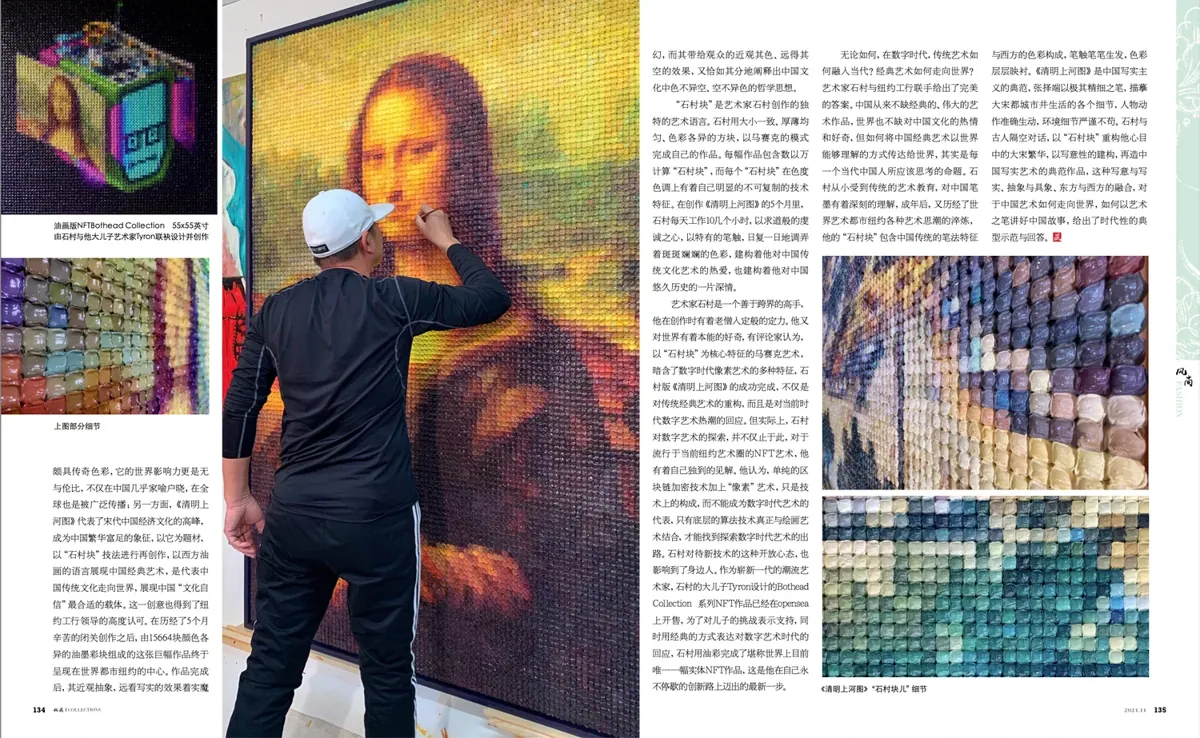
看不见、摸不着的精神力量贯穿了我们,像一条无形的线,穿起所有看得见的珍珠。所谓“大象无形”“大音希声”,说得就是那股看不见的能量,主导着物质世界的走向,如同西方神圣所说,看得见的事物都是暂时的,看不见的事物才是永恒的。从这个层面上来看,《清明上河图》所代表人文精神如同西方艺术史上《蒙娜丽莎》所代表的一样,都是时空中惊鸿一瞥的辉映,照亮了每一个人的心灵而记忆永存。千万年过去,我们今天所处的世界也会飞灰烟灭,但是这个时代留下的结晶却传承这个时代的人文思想、文化的精髓,成为一个时代的精神符号,留给后人诉说。
English text
The Artistic Language of Stone Oil Cube
by Sonia Hu, Collection Magazine, November 2021
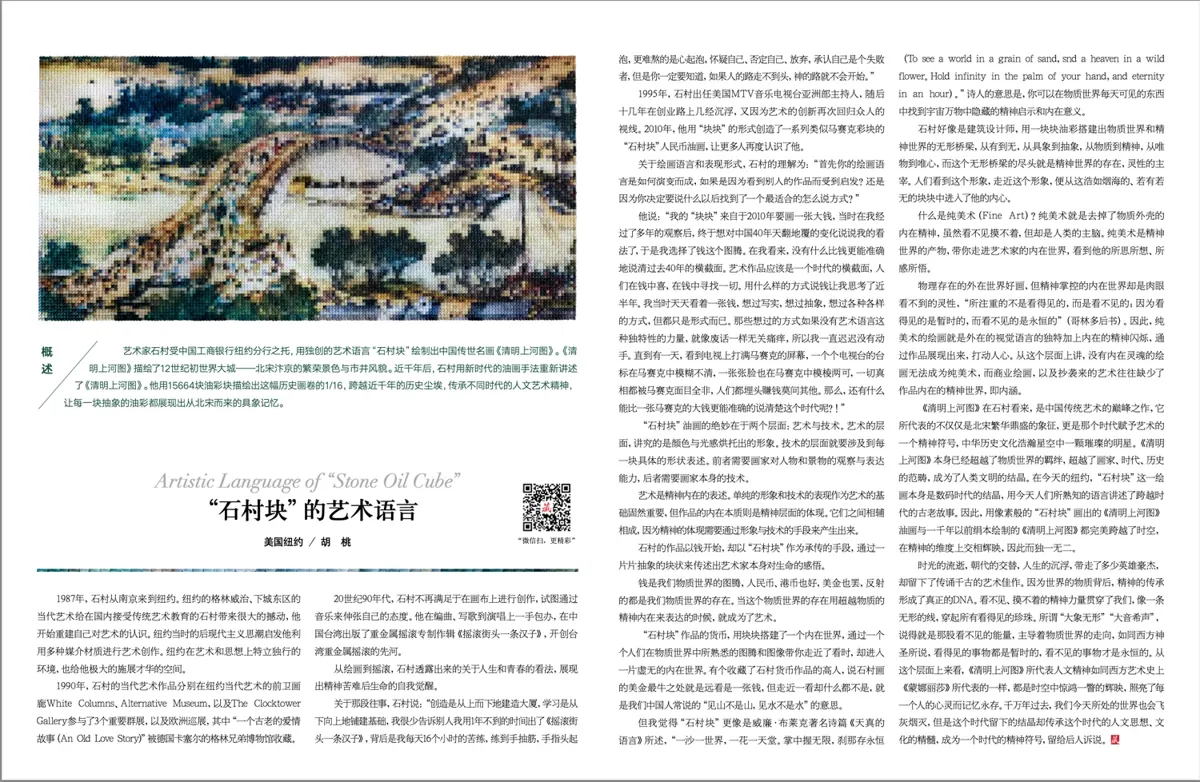
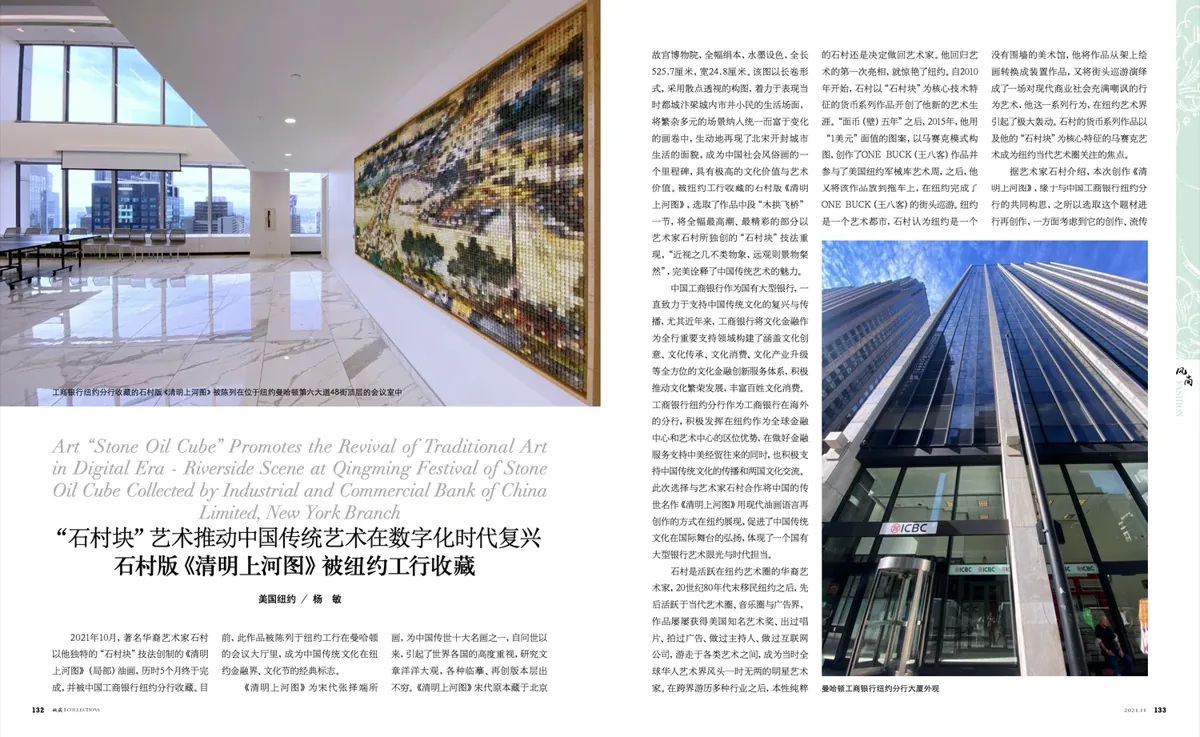
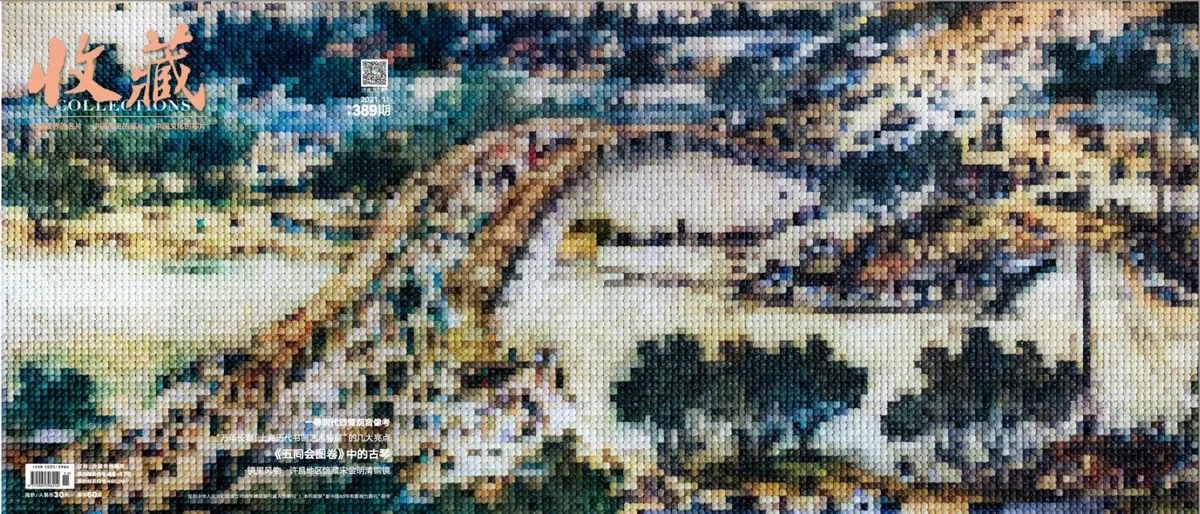
Artist Stone Chun Shi was commissioned by the Industrial and Commercial Bank of China's New York branch to create a rendition of the famous Chinese painting "Along the River During the Qingming Festival" using his unique artistic language, "Stone Oil Cube." "Along the River During the Qingming Festival" depicts the prosperous scenes and marketplace atmosphere of Bianjing, a major city of the Northern Song Dynasty in the early 12th century. Over 900 years later, Stone Chun Shi retells the story of "Along the River During the Qingming Festival" using modern oil painting techniques. He used 15,664 oil color cubes to depict one-sixteenth of this historical scroll, transcending nearly a thousand years of history and inheriting the humanistic and artistic spirit of different times, allowing each abstract oil color cube to reveal concrete memories from the Northern Song Dynasty.
The brilliance of "Stone Oil Cube" paintings lies in two aspects: art and technique. On the artistic level, it emphasizes the portrayal of images through color and light. On the technical level, it involves the specific shape and expression of each cube. The former requires the painter's ability to observe and express people and scenes, while the latter requires the painter's own technique.
Art is the expression of one's inner spirit. While the pure depiction of images and the demonstration of techniques are certainly important foundations of art, the intrinsic essence of a work lies in its spiritual dimension. These aspects complement each other, as the manifestation of the spirit requires the means of image and technique to be brought to life.
Stone Chun Shi's works began with money but used the "Stone Oil Cube" as a means of transmission, conveying the artist's own perception of life through a series of abstract cubes.
Money is the totem of our material world, whether it's RMB, Hong Kong dollars, or US dollars, they all reflect the existence of our material world. When the existence of this material world is expressed through a spiritual essence that transcends materialism, it becomes art.
The "Stone Oil Cube" artwork uses currency to build an inner world, taking you closer to familiar totems and images in the material world yet leading you into a void of an inner world. A connoisseur who has collected Stone Chun Shi's currency artwork said that the most amazing aspect of Stone Chun Shi's depiction of US dollars is that from afar, it looks like a banknote, but when you look closely, it turns out to be nothing, which is what the Chinese often say: "Seeing a mountain is not a mountain, and seeing water is not water."
However, I think "Stone Oil Cube" is more like the famous lines from William Blake's poem "Auguries of Innocence": "To see a World in a Grain of Sand, And a Heaven in a Wild Flower. Hold Infinity in the palm of your hand, And Eternity in an hour." The poet means that you can find hidden spiritual revelations and inner meanings in the everyday objects of the material world.
Stone Chun Shi seems like an architect, using oil color cubes to build an invisible bridge between the material world and the spiritual world, from concrete to abstract, from material to spiritual, and from materialism to idealism. At the end of this invisible bridge lies the existence of the spiritual world and the dominance of spirituality. When people see this image and approach it, they enter his inner world through the seemingly intangible cubes, as vast as a sea of smoke.
Fine Art is the inner spirit stripped of its material shell. Although it is invisible and intangible, it is the essence of human creativity. Fine Art is a product of the spiritual world, taking you into the artist's inner realm, allowing you to see their thoughts, feelings, and insights.
It is easy to depict the physically existing external world, but the inner world governed by the spirit is an invisible, intangible essence. "So we fix our eyes not on what is seen, but on what is unseen, since what is seen is temporary, but what is unseen is eternal" (2 Corinthians 4:18). Therefore, Fine Art painting combines unique external visual language with inner spiritual brilliance, and through the artwork, it touches people's hearts. From this perspective, a painting without an inner soul cannot be considered Fine Art. In contrast, commercial art and plagiarized art often lack the inner spiritual world, or the intrinsic value, of the artwork.
In Stone Chun Shi's view, "Along the River During the Qingming Festival" is a pinnacle of Chinese traditional art. It represents not only the symbol of prosperity in the Northern Song Dynasty but also a spiritual symbol of the art endowed by that era, a brilliant star in the vast expanse of Chinese history and culture. The painting itself has transcended the constraints of the material world, the painter, the era, and history, becoming a crystallization of human civilization. Today, in New York, the Stone Oil Cube painting is a crystallization of the digital age, telling the ancient story across time in a language familiar to people today. Therefore, the "Along the River During the Qingming Festival" oil painting created with pixel-like Stone Oil Cubes perfectly transcends time and space, reflecting each other's brilliance on the spiritual dimension and becoming truly unique.
As time passes, dynasties change, and the vicissitudes of life take away many heroes, but they leave behind artistic masterpieces that are celebrated for centuries. Behind the material world, the spiritual inheritance forms the true DNA. The invisible and intangible spiritual force runs through us, like an invisible thread threading all visible pearls. The so-called "the greatest form is without shape, the greatest sound is silence" refers to that invisible energy, which often dominates the direction of the material world. As the Western sacred teachings say, visible things are temporary, while invisible things are eternal. From this perspective, the humanistic spirit represented by "Along the River During the Qingming Festival" is like the "Mona Lisa" in Western art history, both are fleeting glimpses in time and space, yet illuminating the hearts and memories of everyone.
Millions of years will pass, and the world we live in today will eventually fade away. However, the crystallization of this era will inherit the essence of humanistic thought and culture of this time, becoming a spiritual symbol of an era, left for future generations to recount.
杂志原版 / Original pages