
AMVIA · STONE CHUN SHI’S ARTISTIC JOURNEY
The Creator and the Self He Creates
Stone Chun Shi’s Four Decades of Artistic Exploration: From Mixed-Media Painting and Stonecube to AMVIA
Enter AMVIA ↗Jump to “From Stonecube to AMVIA”阅读中文版Introduction: An Artist Who Refuses to Be Finished
In 1987, at the age of twenty-four, Stone Chun Shi left Nanjing, China, for New York City. He could hardly have imagined the unexpected turns his artistic journey would take over the following four decades.
He would become a young painter immersed in the rebellious atmosphere of downtown New York’s contemporary art scene, combining oil paint, wax, rope, woodcut, and other materials in works shaped by the sensibilities of postmodernism. He would later become an unlikely cultural celebrity in Taiwan, appearing in a groundbreaking advertising campaign, releasing a heavy-metal rock album, and joining MTV Asia. From there, he would enter television production, digital media, and technology entrepreneurship, spending sixteen years away from sustained painting.
Then, in 2010, he returned to the canvas.
Working for nearly a year on a monumental painting of a Chinese banknote, composed of approximately 17,000 individually painted units of color, Stone began developing what would become his distinctive visual language: Stonecube.
Another sixteen years passed. Stonecube evolved from paintings of currency into portraits of Marilyn Monroe, reinterpretations of classical Chinese masterpieces, and explorations of historical and cultural imagery. By then, Stone had established a recognizable pictorial language with its own formal principles.
Yet in 2026, now in his sixties, he once again stepped into unfamiliar territory.
Through AMVIA Human Visual Intelligence, Stone began exploring how an artist’s accumulated visual judgment might inform an intelligent generative system capable of participating in the creation of new artworks.
To an outside observer, such a career might appear to be a succession of abrupt departures. Why would an artist leave painting just as recognition was beginning to arrive? Why abandon a promising career in popular culture to pursue media and technology? And why, after spending sixteen years establishing an independent painting language, would he enter an entirely new and uncertain field?
Viewed together, however, these apparent discontinuities reveal an underlying consistency.
Stone has never been interested merely in mastering an existing form of expression. Throughout his life, he has returned to a more fundamental question: Can an artist create a way of expressing the world that is genuinely his own?
That question runs through his early mixed-media paintings, his experiments with music and moving images, the development of Stonecube, and his present exploration of artificial intelligence.
What changes is the object of creation: first the image, then the visual language through which images are organized, and eventually the system through which new artworks may emerge.
Yet something else changes along the way.
The artist himself.
Stone’s work has not simply reflected his personality, ideas, and experiences. The demands of creation have gradually reshaped his temperament, his habits, his understanding of time, and his relationship with the world.
The artist creates the work, but the work also creates the artist.
In this sense, Stone Chun Shi’s artistic journey is more than the history of a painter developing a distinctive language. It is the story of a creator continually becoming someone new through the act of creation.
I. The Painter Who Never Attended Art School
Stone began drawing at the age of nine. By high school, his artistic ability had attracted the attention of teachers and classmates, who frequently asked him to produce school displays and even murals for newly opened local businesses.
In the late 1970s and early 1980s, China was beginning to reopen itself to the outside world. Western modern art remained largely inaccessible, encountered through a limited number of publications, private collections, and personal exchanges.
Nevertheless, Stone’s artistic education began to take shape within these constraints.
One of his early mentors, He Ye, head of the art department at the Suzhou Institute of Technology, introduced him to reproductions of paintings by Jackson Pollock.
Pollock’s work offered a radically different conception of painting. Rather than treating the canvas primarily as a surface on which to represent recognizable objects, Pollock made bodily movement, the behavior of paint, and the physical act of painting central to the work itself.
For the young Stone, this encounter opened an entirely new field of possibility.
At the same time, a childhood friend named Abo, who had moved to Hong Kong, regularly brought him books and art publications unavailable in mainland China. Stone became particularly fascinated by Paul Klee, whose work he studied so closely that he carried a book of reproductions with him.
These encounters encouraged Stone to think beyond the academic traditions that dominated Chinese art education at the time.
Ironically, although he repeatedly achieved outstanding results in the practical entrance examinations of several art institutions, his overall academic scores prevented him from entering his preferred art schools. According to his recollection, he once missed admission by only seven points.
What appeared to be a serious setback became an unexpected turning point.
An American student studying at Nanjing University saw his paintings and encouraged him to go to New York, convinced that the city would offer greater opportunities for his talent.
In 1987, Stone left Nanjing for New York.
Not having attended a conventional art academy meant that he lacked certain institutional advantages. Yet it also meant that his artistic thinking had not been firmly shaped by a single academic tradition.
Much of his education would take place through independent experimentation and direct encounters with art in New York.
II. New York: An Outsider at the Center of Contemporary Art
New York in the 1980s was a city of extraordinary contradictions.
Financial expansion and consumer culture helped fuel the art market, while the AIDS crisis brought questions of mortality, identity, the body, and social power into urgent focus. Artists working in the East Village, SoHo, and Greenwich Village challenged established boundaries through painting, photography, video, installation, performance, and street culture.
Stone was immediately drawn to this environment.
He settled near the intersection of Bleecker Street and Thompson Street in Lower Manhattan, surrounded by artists, musicians, and communities from diverse cultural backgrounds.
During the day, he visited museums and galleries. Back in his apartment, he painted while listening to the thunderous sound of heavy-metal rock.
New York’s museums became his real art school.
Works he had previously known only through reproductions were suddenly available to him in their original scale and material presence. The thickness of paint, the physical texture of surfaces, and the traces of an artist’s gestures offered lessons that no printed image could convey.
Stone was particularly struck by the practices of David Salle, Robert Longo, Barbara Kruger, and Cindy Sherman. Their work demonstrated how images could do more than represent the visible world: they could question identity, consumption, cultural authority, and the mechanisms of mass communication.
Stone began experimenting with combinations of oil paint, wax, rope, woodcut, and other materials.
His paintings frequently featured skulls, ghosts, human bodies, female figures, and apocalyptic imagery. Death, desire, fear, and the contradictions of human nature became recurring subjects.
These works were emotionally charged, restless, and confrontational.
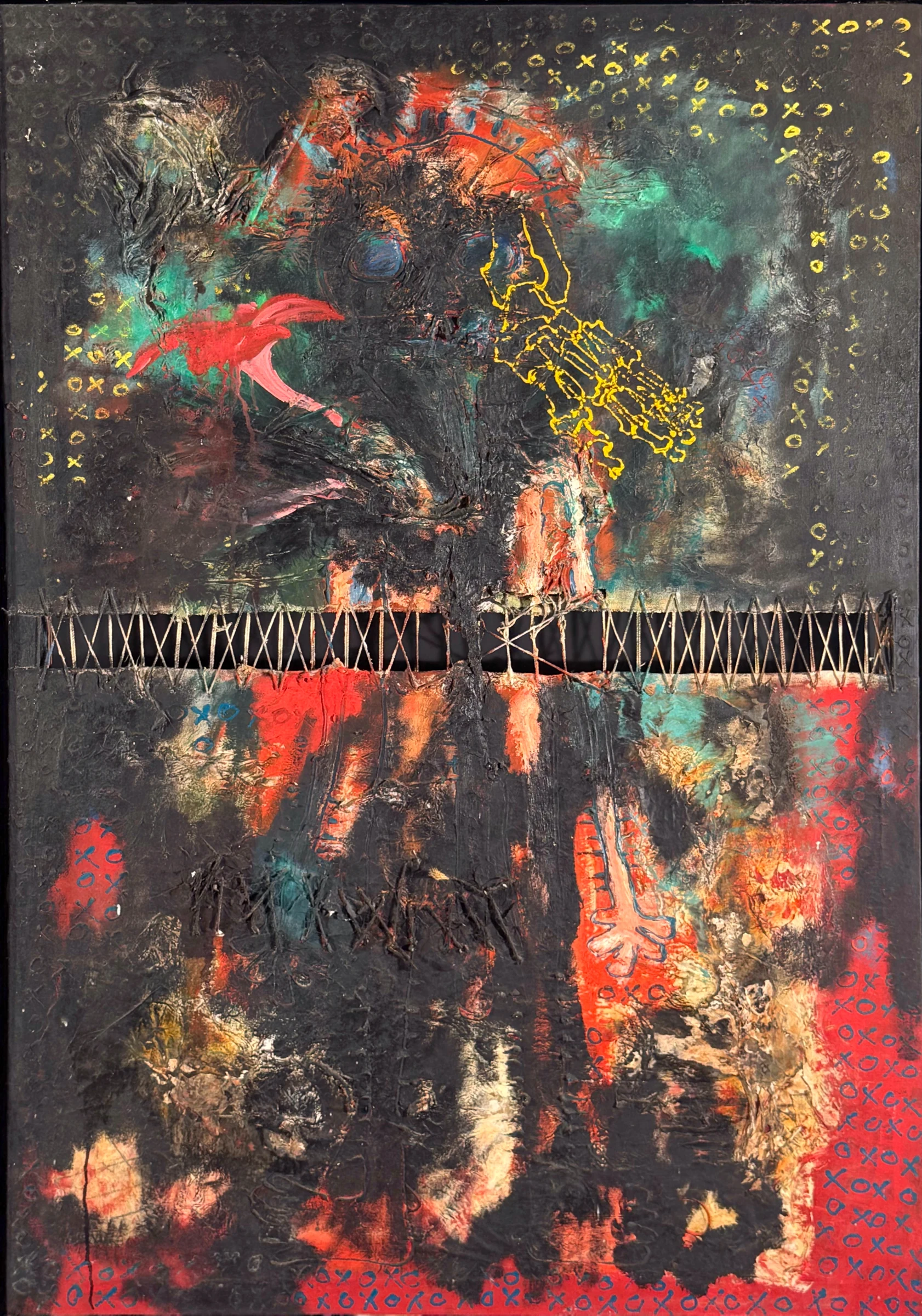
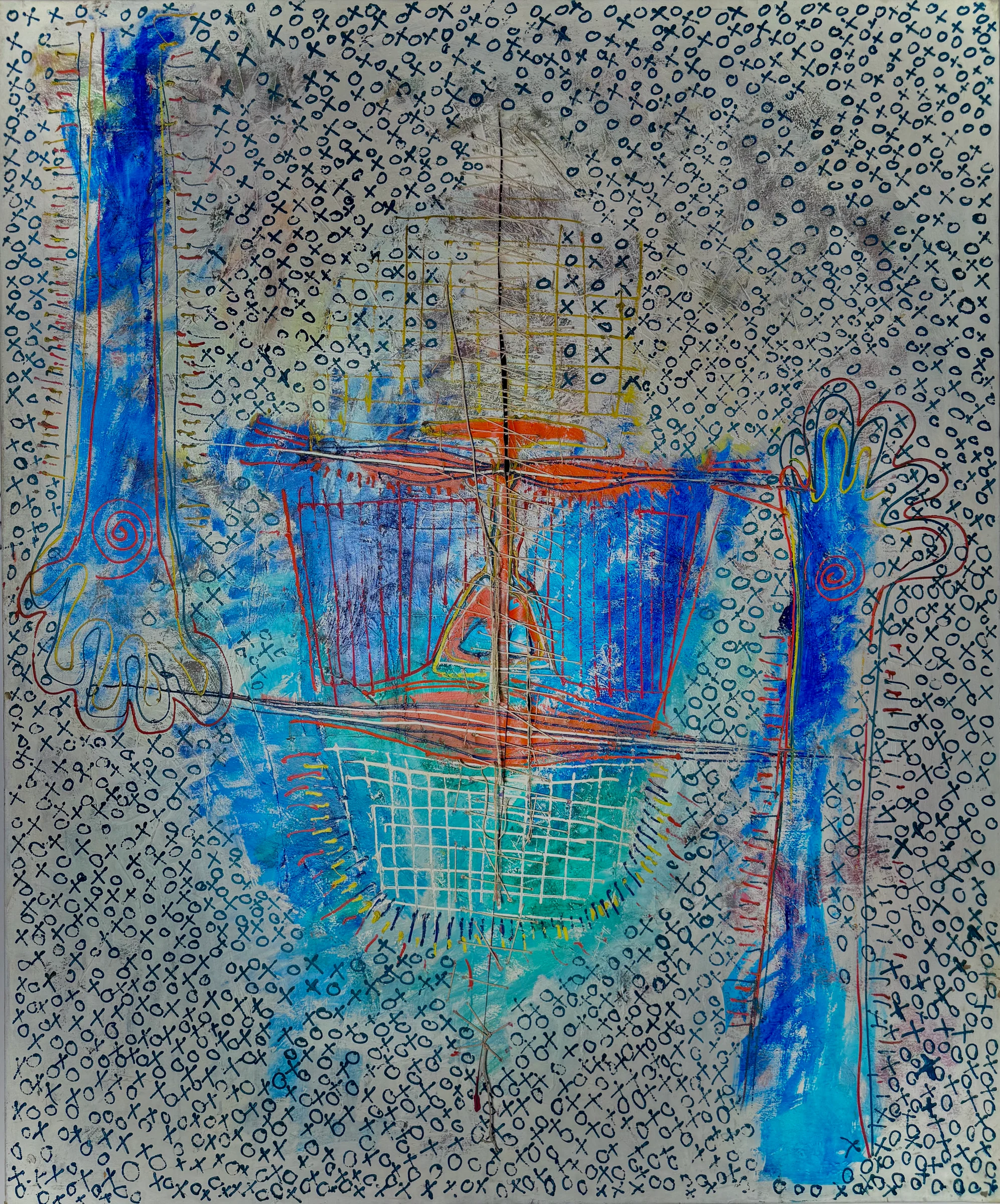
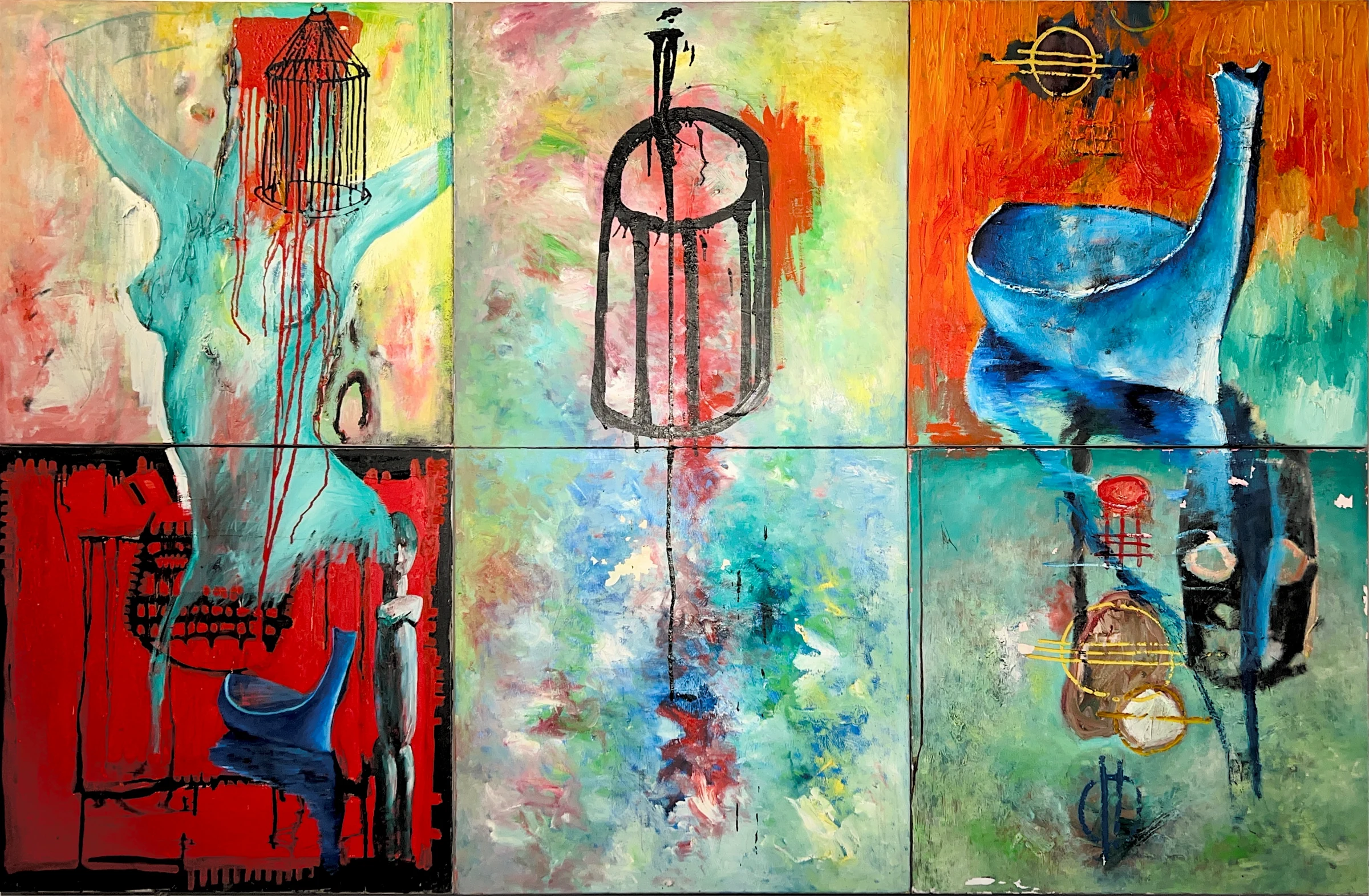
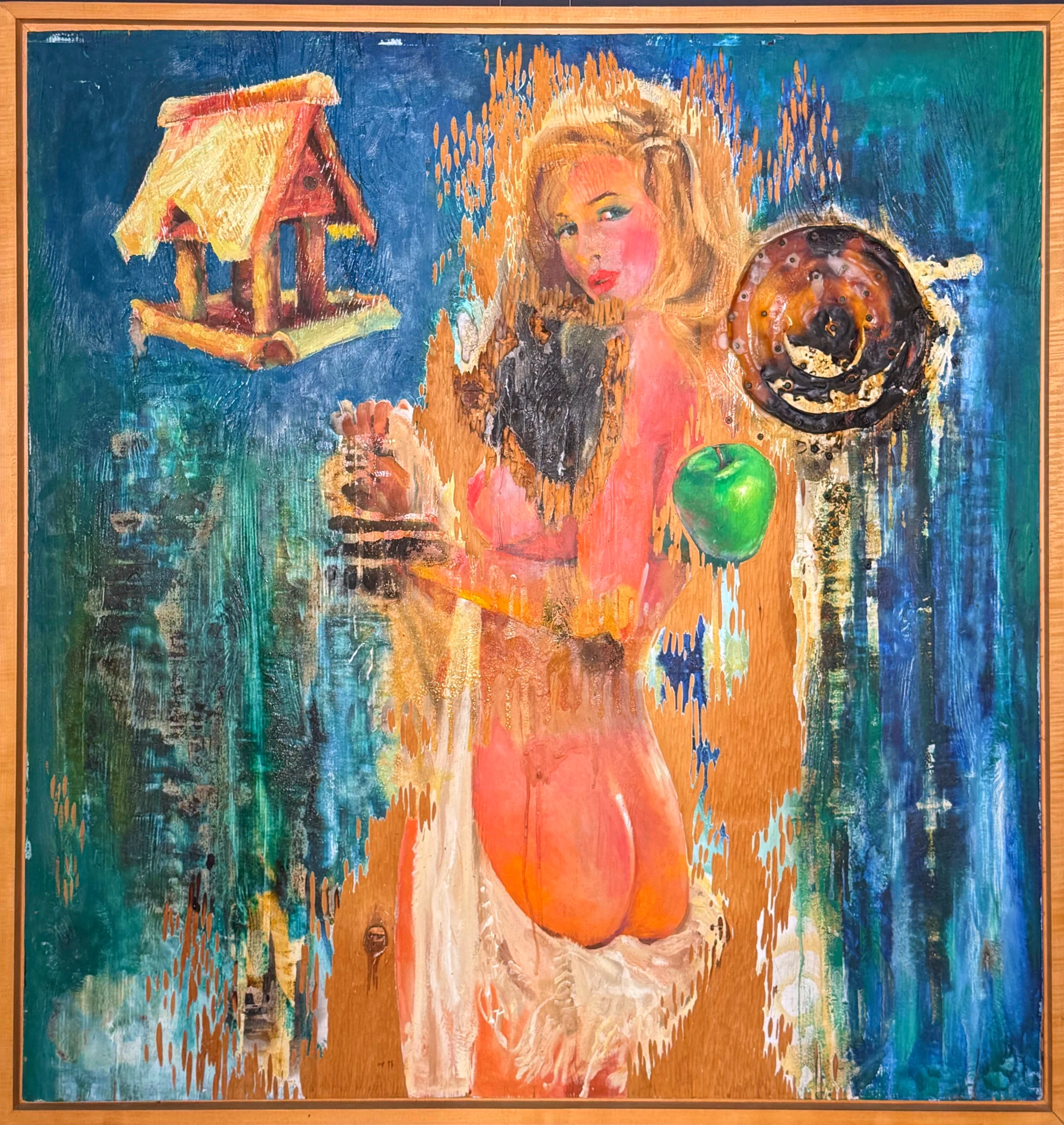
They reflected the atmosphere of downtown New York, but they also carried traces of Stone’s cultural memory. Having grown up in China’s Jiangnan region, he brought with him a different set of associations concerning mortality, history, and the spiritual world.
Between 1988 and 1994, Stone participated in exhibitions at several New York art institutions, including Kenkeleba Gallery, Phoenix Gallery, White Columns, the Alternative Museum, and Clocktower Gallery. His work was also included in exhibitions in Germany, and an early account records the acquisition of one painting by a Grimm museum in Kassel.
Stone was therefore not simply an observer standing outside the contemporary art world. He participated in its experimental culture and received opportunities to exhibit his work.
Yet participation did not necessarily mean belonging.
He remained reluctant to define himself exclusively through the professional identity of a painter. Music, moving images, popular culture, and emerging technologies interested him just as deeply.
That refusal to remain within a single discipline would soon lead to an unexpected departure.
III. 1994: Leaving at the Moment of Recognition
In 1994, Stone was invited to hold solo exhibitions at IT Park Gallery and Apu Gallery in Taiwan.
For a young painter, these exhibitions could have marked the beginning of a more established professional career.
Instead, something unexpected happened.
Taiwanese advertising director Wang Caixiang discovered Stone and cast him in a campaign for Kai Xi Oolong Tea, titled New Generation: New York Story.
Filmed around Stone’s actual life in downtown Manhattan, the commercial brought together his paintings, heavy-metal music, distinctive appearance, and unconventional attitude toward life.
The campaign attracted considerable attention, and Stone unexpectedly became associated with Taiwan’s emerging “New Generation” youth culture.
A painter who had been experimenting in contemporary art galleries was suddenly entering the world of mass media and popular entertainment.
Gallery representatives became concerned that celebrity and public exposure might interfere with the sustained solitude they believed serious painting required. Stone was encouraged to choose between the life of a dedicated painter and that of a public performer.
He chose music.
He released a heavy-metal album, A Rocker on the Streets, and in 1995 joined MTV Asia in Singapore, working in music television production and presentation.
This was more than a career change.
Stone did not regard painting, music, and moving images as entirely separate forms of creativity. Each offered different possibilities for expressing ideas, emotions, and experiences.
Yet looking back, he also acknowledged that his younger self had not been ready for the prolonged solitude of a painter’s life.
He was drawn to movement, experimentation, and the excitement of unfamiliar opportunities. He had not yet developed the patience required to remain in a studio, working on the same canvas day after day.
Years later, during an interview on the Chinese-language television program Hello New York, the host asked why he repeatedly seemed to leave just as success was approaching.
Stone replied that he had always been searching for an artistic method capable of fully expressing his inner thoughts.
“Have you found it now?” the host asked.
“Yes,” Stone answered without hesitation.
By then, he was referring to the painting language that would become Stonecube.
His response offers an important key to understanding his seemingly unpredictable choices.
External recognition does not necessarily mean that an artist has resolved the deeper problem of expression. A person may succeed in a particular profession while still feeling that the essential language of his creativity remains undiscovered.
Stone’s repeated departures were not simply evidence of restlessness. They reflected an unwillingness to mistake professional achievement for artistic fulfillment.
IV. Sixteen Years Away from the Canvas
From 1994 to 2010, Stone was no longer engaged in sustained painting.
Viewed solely through the conventional biography of a painter, these years might appear to constitute a long interruption.
But they were not an interruption of creativity.
At MTV, Stone encountered the complex relationships among music, moving images, editing, programming, and mass communication. He later established a media production company in New York, developing projects intended to bring American television content to Chinese audiences, including 60 Minutes in America.
As the internet expanded, he explored digital platforms and technology ventures, including a proposed real-time commercial service called Yao A Yao, as well as later mobile application development.
Not all these projects achieved commercial success. Some encountered difficulties involving financing, market conditions, or technological limitations.
Nevertheless, they broadened Stone’s understanding of what it meant to create.
A painter generally works directly with materials to produce a specific object. Media and technology projects require a creator to think about content organization, distribution, user behavior, and the conditions through which a system produces continuing results.
Creation, in this context, is not necessarily limited to a finished image or program. It may also involve designing a structure through which content, relationships, and experiences are generated.
It would be misleading to interpret these sixteen years as a deliberate preparation for AMVIA. Stone could not have foreseen the development of contemporary generative artificial intelligence.
But retrospectively, these experiences gave him an understanding of creative systems that extended well beyond traditional studio practice.
Throughout this period, Stone retained an artist’s sensitivity to social change.
In 2005, he returned to Beijing and Shanghai to pursue technology projects. Eighteen years had passed since he left Nanjing.
The transformation of Chinese society astonished him.
In his view, money and wealth had become increasingly powerful measures of personal success and social status. Economic development had transformed the physical landscape, but it had also altered relationships, ambitions, and the way people understood value.
He began wondering how painting might address these changes.
One familiar object gradually captured his attention: the Chinese 100-yuan banknote.
V. The First Renminbi: A Banknote That Changed Its Painter
In 2010, Stone began developing the idea for a monumental painting based on a Chinese banknote.
He placed a 100-yuan note before him and studied it repeatedly for months.
Currency is among the most standardized images in modern society. It represents exchange value, institutional authority, and collective trust, while also carrying associations with wealth, desire, power, and individual destiny.
But how could money become art without simply reproducing its appearance?
A realistic enlargement might amount to little more than a giant banknote. Excessive abstraction might remove the very social meaning Stone wanted to address.
He needed a new visual method that would preserve the image’s recognizability while fundamentally changing the experience of looking at it.
At the time, mosaic-like pixelation was widely used in television and public media to obscure faces or sensitive images. A recognizable image could be broken into units of color until its identity became difficult to perceive.
This suggested a reversal.
If pixelation could conceal an image, why could individually painted units of color not be used to reconstruct one?
Stone decided to divide the banknote into thousands of separate visual units and paint them individually in oils.
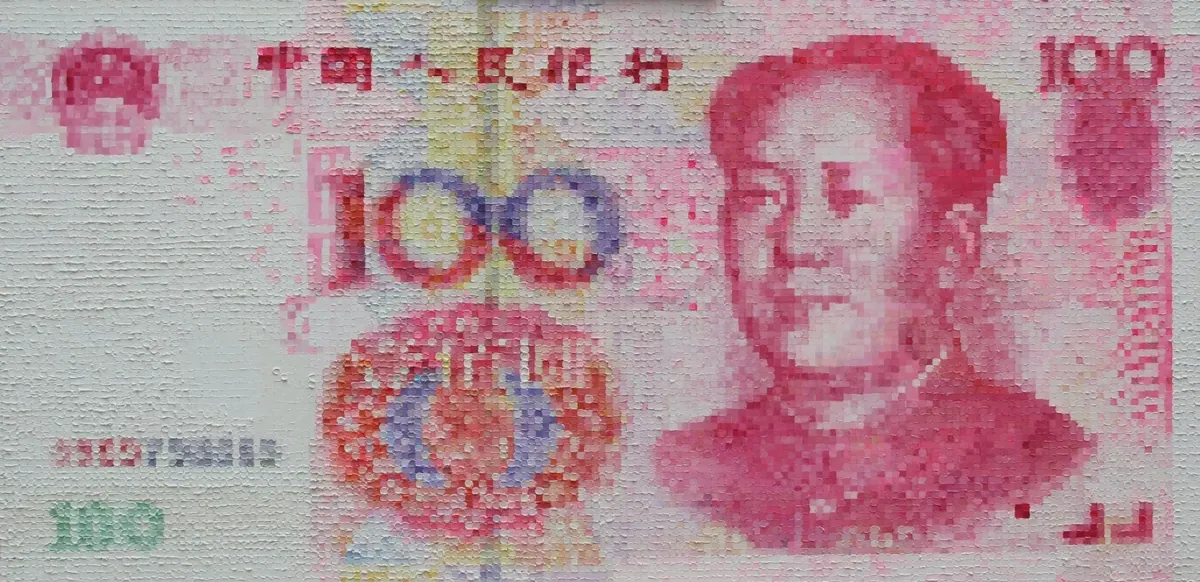
The resulting work, approximately three meters high and 2.6 meters wide, consisted of roughly 17,000 painted units.
The image caption in the Artron report records dimensions of 130 × 262 cm for this work, which differ from the dimensions given in the essay.
But once he began, Stone discovered that the greatest obstacle was not technical.
It was himself.
After completing only a dozen or so units, he became restless and frustrated. The task seemed almost impossible.
He had spent much of his adult life moving rapidly between projects and environments. Now he faced an enormous canvas that required the repetition of nearly identical actions, while demanding individual decisions about the color, shape, and placement of every unit.
He began changing the music he listened to, adjusting his working rhythm, and learning to settle his attention.
Day after day, one painted unit followed another.
Stone later compared the experience to climbing a steep mountain. At the beginning, the summit seemed impossibly distant. Each completed section revealed how much work remained.
Nearly a year passed before he finished the painting.
When friends first encountered the monumental work, they were astonished by its scale and visual complexity.
For Stone, however, the experience had become something far more consequential than the completion of an impressive painting.
The process had changed him.
He began to understand that sustained concentration was not merely a restriction on personal freedom. It could also become a source of freedom.
He called the method “Zen Mosaic.”
The reference to Zen was not intended as a strict religious classification. Rather, it expressed his growing association between painting, sustained attention, inner stillness, and spiritual discipline.
One might playfully describe the experience this way: Bodhidharma faced a wall for nine years; Stone faced a banknote and discovered the discipline of painting.
Stone had begun by trying to express his observations about money and society.
What he discovered through the process was something money could not purchase: a different relationship with his own mind.
VI. Stonecube: From the Gesture of the Brush to an Independent Visual Language
The completion of the first renminbi painting marked the beginning of a new visual language, not its final realization.
Over the following years, Stone continued developing the method he initially called Zen Mosaic and later named Stonecube.
At first glance, Stonecube may recall traditional mosaics, digital pixels, or the divided-color techniques of Neo-Impressionism. Yet its fundamental units and organizing principles are different.
Traditional mosaics generally assemble images from prefabricated pieces of material. Digital pixels function as standardized units of image information. Stonecube, by contrast, consists of individual units of oil paint created through the artist’s physical gestures.
Each unit possesses a relatively independent form while retaining traces of the brush’s movement.
Its thickness, edges, direction, color, and interaction with light give it a material presence beyond that of a flat patch of color.
Stone draws upon the gestural consciousness of Chinese calligraphy.
In the calligraphic tradition, a brushmark is not simply a means of constructing a character. It also records the rhythm of the body, variations of pressure, and the movement of the writer’s attention.
Stonecube transforms this understanding of the brushmark into a volumetric unit of oil paint.
Yet its significance extends beyond the combination of Chinese calligraphy and Western painting.
More fundamentally, Stonecube reorganizes the relationship between the individual brushmark and the overall image.
When viewers approach the canvas, they encounter an arrangement of relatively autonomous abstract forms. The thickness of the paint, the movement of the brush, and subtle differences in color dominate their perception.
As they move farther away, the separate units begin to establish visual relationships. Figures, landscapes, or historical scenes gradually emerge.
From nearby, the work appears abstract.
From a distance, it becomes representational.
These are not two competing styles but two simultaneous conditions of the same painting.
Through their own movement, viewers experience the image emerging from the relationships among its constituent parts.
Stonecube can therefore be discussed alongside Georges Seurat’s divided-color painting, Jackson Pollock’s action painting, and broader modernist investigations of material, gesture, and perception.
But the comparisons also clarify its differences.
Seurat explored the organization of light and color through divided marks. Pollock emphasized the direct traces of bodily action. Stone seeks to preserve the individual material identity of gestural painted units while allowing them collectively to form recognizable images.
Stonecube is not simply an image broken into small pieces.
Its central artistic proposition lies in transforming the brushmark from a subordinate instrument of representation into the fundamental unit through which the entire image is organized.
Within this language, every unit retains its own form while depending on its relationship with neighboring units.
The whole is not merely a mechanical sum of its parts. It is a visual order emerging from countless local differences.
This gives Stonecube a distinctive formal philosophy: individual freedom and collective order need not be mutually exclusive.
VII. From Currency to Marilyn Monroe and Classical Chinese Painting
An unusual painting technique may produce striking visual effects without necessarily becoming a mature artistic language.
A genuine visual language must be capable of developing across different subjects, scales, and cultural contexts while maintaining a recognizable structural logic.
Stonecube’s development can be understood through its expansion beyond currency.
In his banknote paintings, Stone transforms standardized economic symbols into images constructed through prolonged manual labor. The exchange value represented by money comes into tension with the artist’s investment of time and physical effort.
This invites comparison with Andy Warhol.
Warhol used silkscreen printing and repetition to explore the relationship between art, mass production, and consumer culture. Stone follows a different path: he reconstructs standardized public images through thousands of individually executed painterly decisions.
Both artists engage with familiar images circulating in modern society, but the methods through which those images acquire artistic meaning differ significantly.
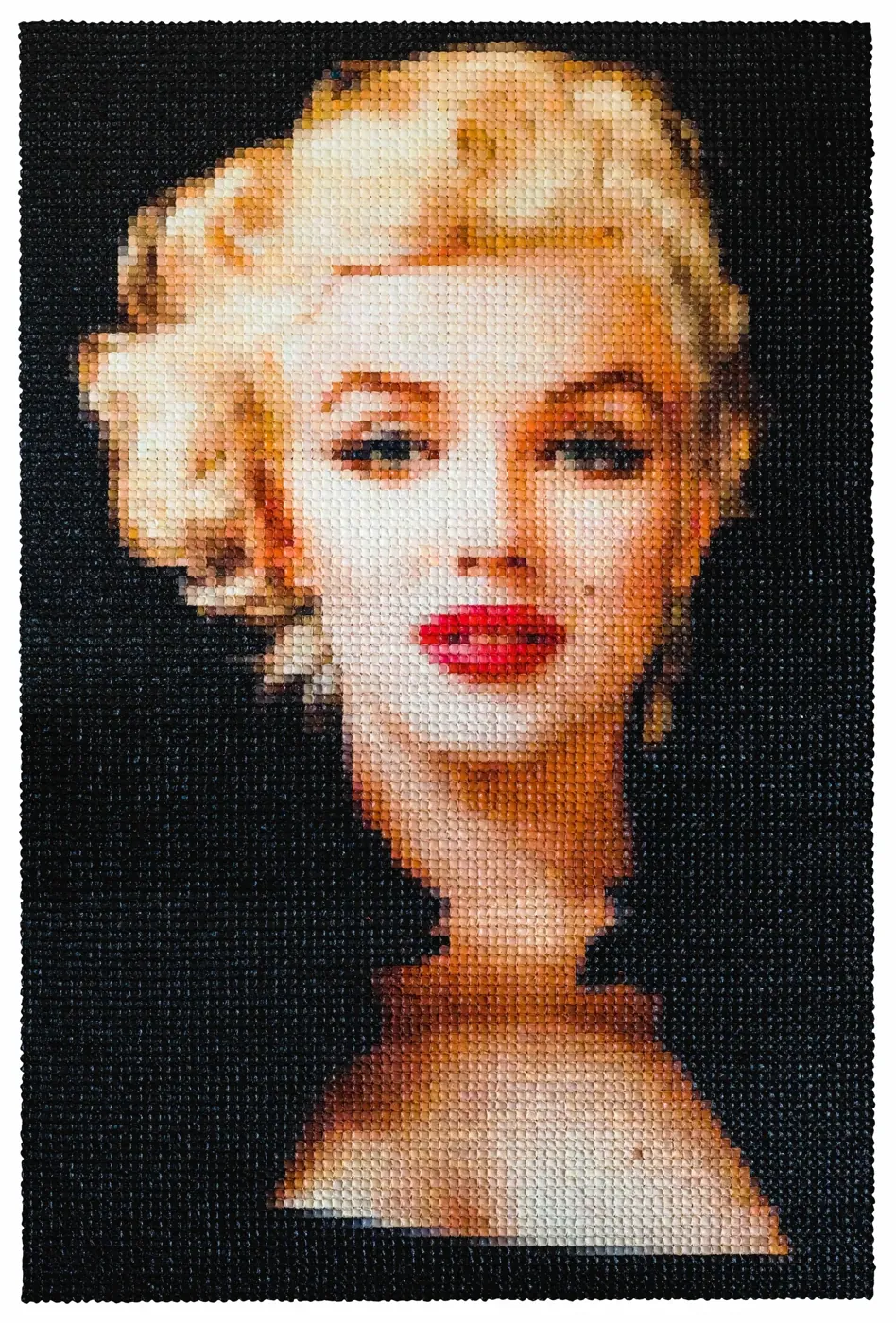
Stone’s Marilyn Monroe paintings extend this investigation into the relationship between public imagery and individual identity.
Monroe has become one of the most recognizable cultural icons of the twentieth century. Repeated through photography, cinema, advertising, and Pop Art, her image has acquired meanings that extend far beyond the historical person.
In The Last Marilyn, Stone attempts to move beyond the familiar symbol of glamour and sexuality, presenting his own interpretation of Monroe’s emotional and psychological life.
Her hair, facial expression, and tonal relationships are reconstructed through numerous individually painted units.
From a distance, viewers recognize the familiar face. At close range, that public image dissolves into abstract gestures and material textures.
The painting moves between cultural icon and imagined individual, between recognition and the physical reality of paint.
Stonecube subsequently entered the world of classical Chinese painting.
In 2021, commissioned by the New York branch of the Industrial and Commercial Bank of China, Stone reinterpreted a section of Zhang Zeduan’s Northern Song dynasty masterpiece Along the River During the Qingming Festival.
The painting reconstructs approximately one-sixteenth of the original composition through 15,664 individual units of oil paint.
The original handscroll is significant not only for its depiction of urban life but also for its distinctive experience of space and time. As the scroll unfolds, viewers encounter a continuous visual journey through architecture, human activity, and the rhythms of historical society.
Stone’s reinterpretation transforms part of that continuous pictorial narrative into an image constructed from thousands of separate painted units.
Two experiences of time intersect.
One is the historical time carried by the original painting and its nearly thousand-year cultural legacy.
The other is the time of Stone’s own labor, accumulated through the repeated acts of painting that reconstruct the historical image.
From a distance, viewers recognize a scene from Chinese art history. Up close, the scene dissolves into the material presence of contemporary brushmarks.
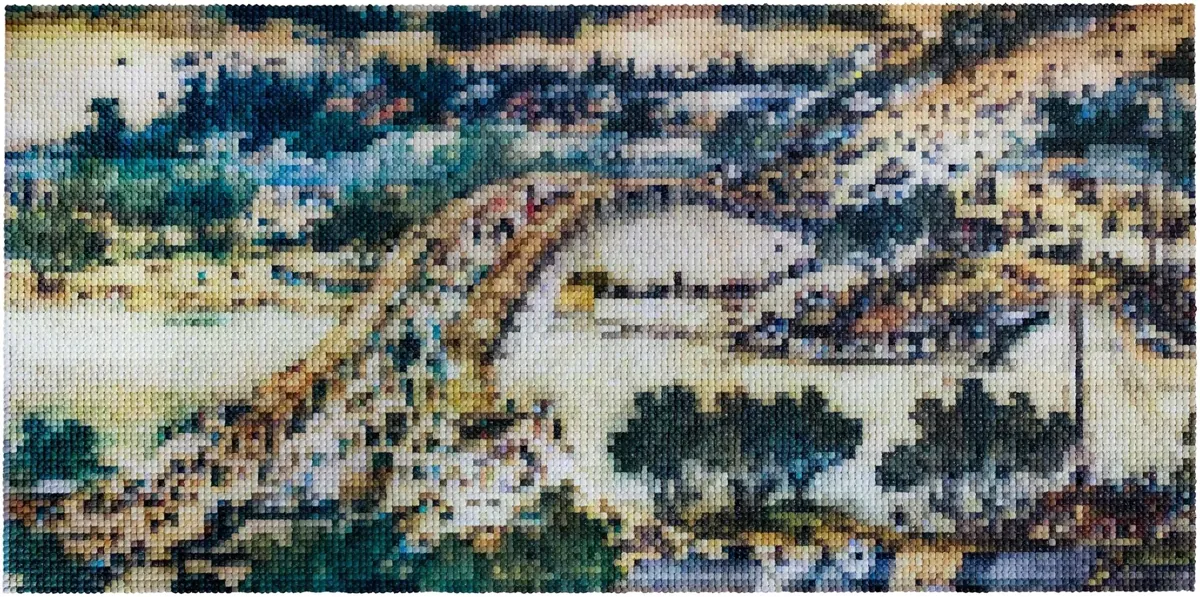
Stone later continued this exploration through reinterpretations of other classical Chinese works, including A Thousand Li of Rivers and Mountains.
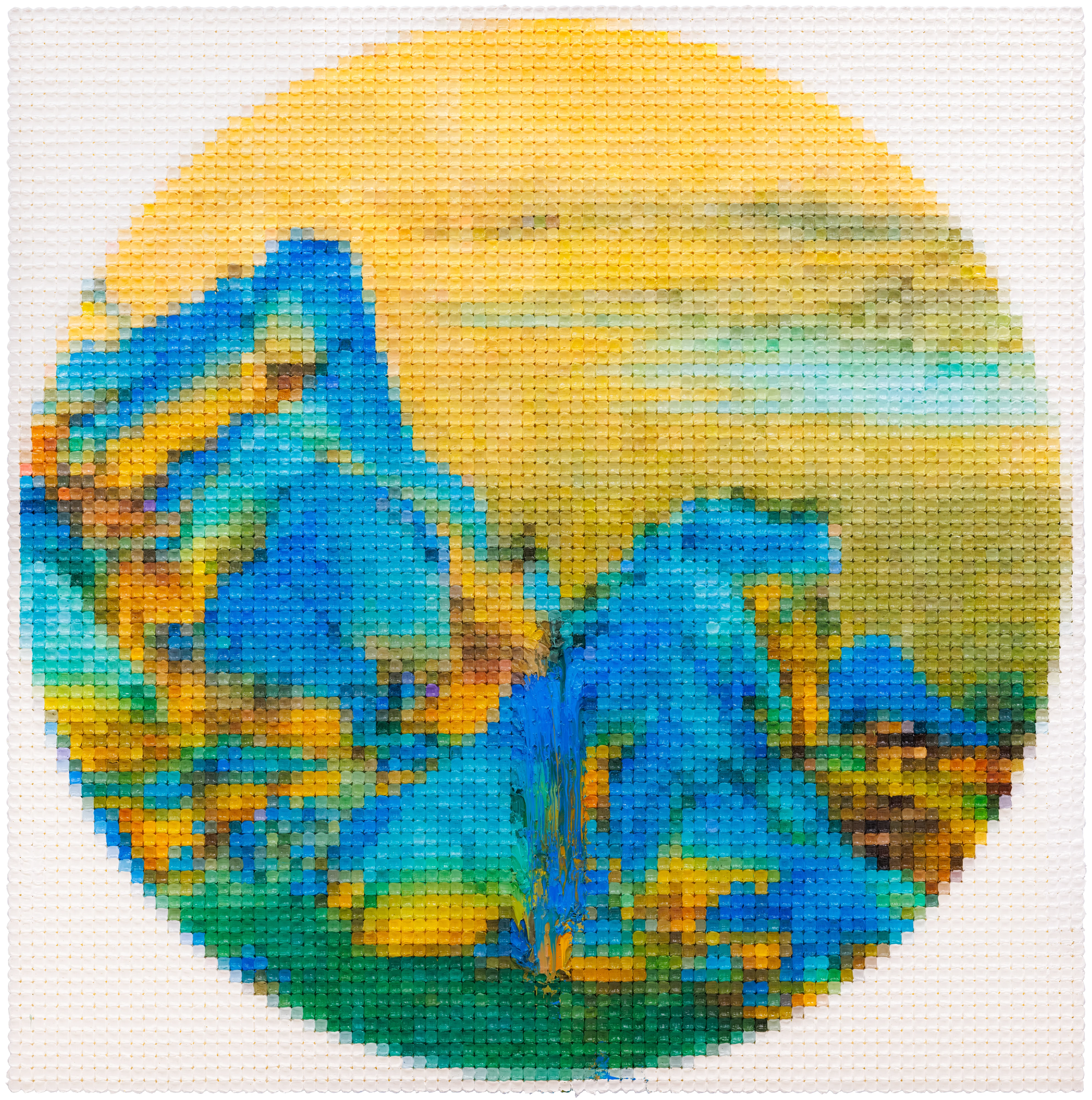
These paintings demonstrate that Stonecube is not confined to a particular subject. It can reorganize images across different cultural contexts while preserving its fundamental visual logic.
The maturity of an artistic language does not lie in producing the same effect indefinitely, but in remaining capable of new expression.
VIII. How an Artistic Language Transforms Its Creator
Stonecube changed more than Stone’s paintings.
It changed his life.
As a young man, Stone had expressed inner conflict through mixed-media painting, released emotional energy through heavy-metal music, and sought new possibilities through media and technology ventures.
After 2010, he gradually became accustomed to spending long periods alone in his studio, finding satisfaction in the slow accumulation of painted units.
The transformation was not immediate.
The first renminbi painting initially confronted him with frustration, exhaustion, and an almost unbearable demand for repetition. To complete it, he had to alter his habits, develop patience, and learn to remain attentive for extended periods.
Over time, he increasingly connected music with painting, using his own guitar performances to help regulate his attention and creative rhythm.
He associated these experiences with the psychological concept of flow and explored their possible connections with Eastern philosophical ideas concerning concentration, stillness, and the self.
The concept of flow can help explain the experience of deep absorption in an activity. Stone’s further interpretation of that experience as a form of spiritual cultivation belongs to his personal philosophy.
The distinction matters.
What is most significant is that painting ceased to be merely a vehicle for expressing ideas. It became a way of organizing Stone’s daily life and inner experience.
He once wrote:
“A work of art is a record of character. Who are you? What do you want to say? How do you say it? I mosaic a year of my life, laying it down piece by piece, steadily, like time itself. What you collect is a cross-section of my life.”
This statement reveals an understanding of artistic value that goes beyond the finished visual object.
A painting contains not only color, form, and material, but also the time the artist has invested in its making.
Every painted unit represents a moment in which the artist stopped, considered, decided, and acted.
The work becomes a material record of lived time.
At the same time, the investment of that time gradually changes the person who creates it.
We commonly imagine that an artist first develops a mature personality and artistic vision, then expresses them through works of art.
Stone’s experience suggests that the relationship is more reciprocal.
He did not first acquire the patience required to create Stonecube.
He developed that patience through the sustained practice of creating it.
Stone created Stonecube, and Stonecube, in turn, helped create Stone.
IX. Two Periods of Sixteen Years: Exploration and Concentration
Looking back across Stone’s career, one temporal symmetry is especially striking.
From 1994 to 2010, he spent sixteen years away from sustained painting.
From 2010 to 2026, he devoted another sixteen years to developing Stonecube.
On the surface, these periods represent almost opposite ways of living.
During the first, Stone moved through music, moving images, media, and technology, exploring the different forms and structures through which creativity could operate.
During the second, he remained committed to a stable painting language, investigating how deeply a particular method could be developed through sustained practice.
The first was an outward exploration.
The second was an inward deepening.
One demanded risk; the other demanded perseverance.
Yet these capacities were not contradictory.
Stone was capable of leaving a field after receiving recognition, but he was also capable of dedicating sixteen years to a single visual language once he found it.
As a young artist, he often relied on changes in his external environment to stimulate creativity.
Later, he learned to discover extraordinary variation within an apparently stable structure.
By 2026, these two bodies of experience had begun to intersect.
Stone understood both the slow formation of a painting language and the ways media and technology systems could organize content, participation, and experience.
This intersection provides an important context for understanding AMVIA.
But it would be a mistake to turn his life into a predetermined sequence.
When Stone left painting in 1994, he did not know that sixteen years later he would develop Stonecube. When he began studying the renminbi in 2010, he could not have foreseen the technological environment of generative artificial intelligence in 2026.
His artistic journey emerged through concrete choices, historical circumstances, and unexpected encounters.
That unpredictability is itself part of the nature of creation.
X. From Stonecube to AMVIA: Creating the Conditions for Art to Emerge
In 2026, Stone began extending his artistic practice into generative artificial intelligence.
This time, he was not confronting a new painting material but a technological environment capable of transforming how images are produced and how people participate in artistic creation.
Artificial intelligence has made image generation increasingly accessible. Complex visual results can now be produced through text, photographs, and other forms of input without requiring the traditional technical skills of painting.
But the increasing ease of producing images does not automatically resolve the deeper questions of artistic creation.
When machines can generate images rapidly and in enormous quantities, where does the distinctive value of an artist reside?
Is art simply the production of an appealing image, or does it also involve judgment concerning form, space, emotion, and cultural meaning?
Stone does not regard artificial intelligence merely as a tool that executes instructions. He is interested in exploring it as a creative partner.
AMVIA Human Visual Intelligence emerges from this line of inquiry.
Rather than simply reproducing a recognizable artistic style, AMVIA seeks to bring together an artist’s visual judgment, real living spaces, and the personal stories of those who inhabit them.
A person may begin with a photograph of a living room, bedroom, or workplace and explore artworks created specifically for that environment.
The process may also incorporate photographs of people, pets, family memories, or personal experiences, allowing these elements to inform the resulting artwork.
Art, in this model, is not simply an object produced elsewhere and subsequently placed within a room.
It begins with the space itself and the life taking place within it.
Stone’s ambition is to bring the visual judgment accumulated through more than four decades of artistic practice and art-historical study into an intelligent generative system.
Such judgment cannot be reduced to a fixed painting style.
It involves color relationships, composition, visual rhythm, spatial sensitivity, image organization, and the capacity to make aesthetic decisions in response to changing conditions.
In Stonecube, the artist directly determines the color, form, and placement of each unit of paint.
In AMVIA, he attempts to influence the formation of images through system design, generative conditions, and visual selection.
The two practices share an underlying concern with artistic organization, but they remain fundamentally different.
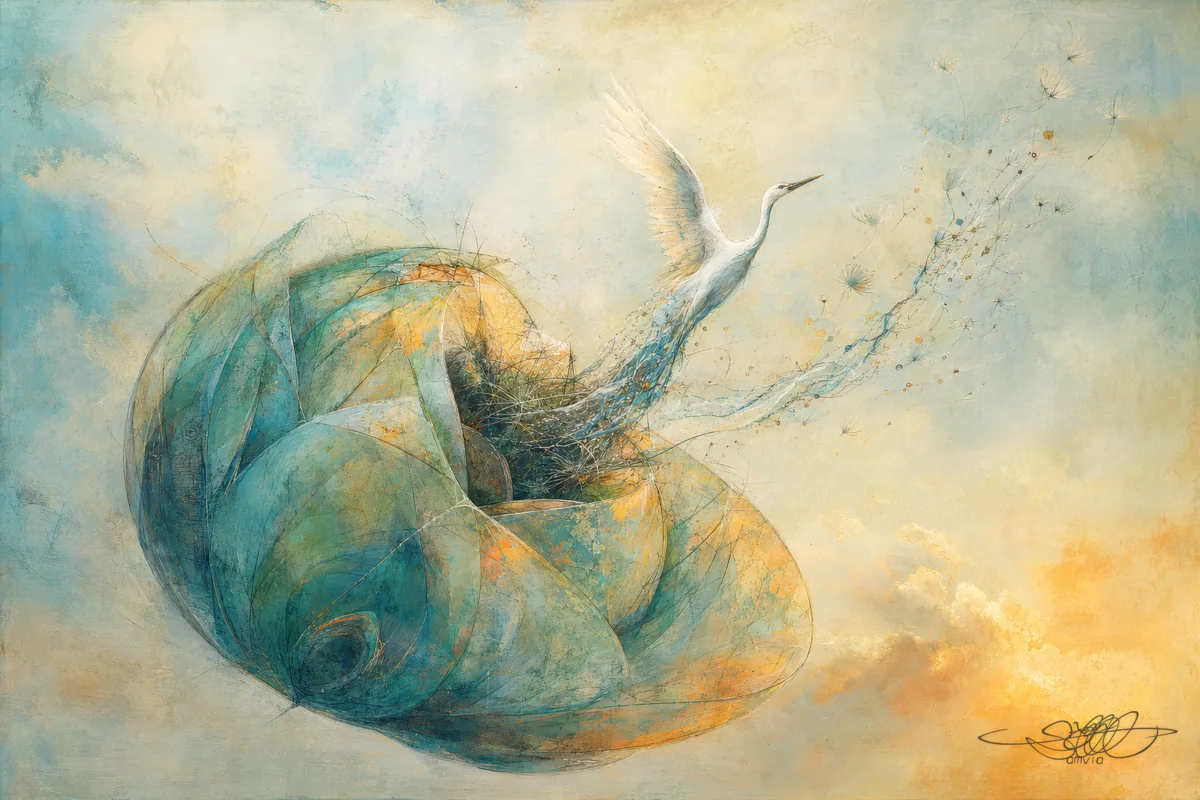

Stonecube is rooted in the material presence of oil paint and the irreplaceable physical actions of the artist.
AMVIA relies on intelligent generation and user participation, making the production of artworks more open-ended and potentially scalable.
AMVIA is therefore neither a digital reproduction of Stonecube nor its inevitable final form.
It represents a change in the object of artistic creation.
Previously, Stone directly created individual paintings.
Now, he is exploring whether an artist can design a system through which new artworks continue to emerge.
From an art-historical perspective, this practice invites comparison with conceptual art, systems art, participatory art, and generative art.
Within these traditions, artistic meaning may reside not only in the final material object but also in the rules, structures, relationships, and conditions established by the artist.
Of course, whether a generative platform can establish independent artistic significance cannot be determined by artistic intention alone. It must also be examined through its actual design, generated works, and the experiences of its participants.
AMVIA remains a developing practice. Its artistic potential and achievements will need to be evaluated as the system and its body of work evolve.
Nevertheless, it already raises a compelling question:
As technology becomes increasingly capable of producing images, might artistic creativity extend further into the design of the conditions through which art comes into being?
For Stone, this is not an abandonment of painting.
It is another inquiry into the nature of creation itself.
XI. An Outsider to Art, a Maverick of His Time
In 2017, I wrote an essay about Stone titled An Outsider to Art, a Maverick of His Time.
By then, he had been painting again for seven years and was gradually receiving recognition from galleries and collectors.
I was trying to understand why an artist who had participated in New York’s contemporary art scene would suddenly leave painting in 1994, only to return sixteen years later with an entirely different visual language.
At the time, I believed Stone had finally discovered the form of expression he had spent much of his life seeking.
There were good reasons for that conclusion.
Stonecube had brought his artistic ideas, materials, techniques, and personal experience into a new kind of unity. He no longer needed to move constantly between different media in search of a language. He could continue creating within a stable system of his own making.
Yet nine years later, with the emergence of AMVIA, I began reconsidering what I had meant by “outsider” and “maverick.”
Stone has never truly stood outside his time.
On the contrary, he has repeatedly entered some of the most active cultural and technological environments of successive eras.
In the 1980s, he participated in the experimental world of downtown New York art.
In the 1990s, he entered rock music and MTV.
During the rise of the internet, he explored media and technology entrepreneurship.
After 2010, he returned to painting and developed an independent visual language.
And in the age of artificial intelligence, he has once again begun exploring unfamiliar possibilities for creation.
Stone has remained sensitive to the changes of his time without allowing any particular era’s definition of success to determine the limits of his life.
To be an outsider, in this sense, does not mean refusing to participate.
It means refusing to belong completely to any predetermined identity.
To be a maverick does not mean rejecting collaboration. It means retaining the capacity for independent judgment when confronted with choices about art and life.
Stone could enter the center of the art world and later leave it. He could become a public figure and then return to the solitude of the studio. He could devote sixteen years to developing a painting language and, in his sixties, begin exploring an entirely new field.
These decisions sometimes cost him opportunities that might have produced greater conventional success.
But they also preserved his freedom to redefine himself.
Looking back today, I realize that the Stone I described in 2017 was not a finished artist.
He had completed an important stage of his creative life.
What I could not yet see was that he would continue to change.
XII. The Creator and the Self He Creates
What, ultimately, is the relationship between an artist and the work he creates?
We usually think of the artist as the creative subject and the artwork as the result.
The artist expresses ideas, emotions, and aesthetic judgments through the work.
Stone’s life suggests a more complex relationship.
In the 1980s, his mixed-media paintings expressed his fascination with mortality, desire, and the contradictions of human nature. They were restless and confrontational, much like the young artist himself, who was passionate, sensitive, and unwilling to remain within a stable way of life.
After 1994, Stone moved into music, media, and technology. These experiences did more than provide new professional skills. They changed his understanding of creation, communication, and social relationships.
In 2010, he returned to the canvas and began the first renminbi painting.
This time, the work did not simply receive the artist’s expression.
It made demands upon him.
To complete approximately 17,000 painted units, Stone had to change his rhythm, develop concentration, and learn the discipline of sustained effort.
The work gradually reshaped his daily life.
Over the following sixteen years, the continued practice of Stonecube helped him establish a new inner order.
It would therefore be misleading to say that Stone created Stonecube only after becoming a mature and disciplined artist.
Rather, through the process of creating Stonecube, he gradually became the kind of artist capable of sustaining such a practice.
AMVIA introduces another dimension to this reciprocal relationship.
As Stone attempts to bring his visual judgment into an intelligent generative system, he must reconsider the relationship between artist and technology, artwork and participant, individual intention and systemic generation.
The new creative practice may, in turn, transform his understanding of art and of his own identity.
Stone’s career is therefore not simply the story of a fixed self expressing itself through different works.
The creator known as Stone Chun Shi has also been formed through the changing practices of creation.
He creates paintings, and painting changes him.
He develops a visual language, and that language reorganizes his life.
He attempts to create a system, and the system confronts him with new questions about art, technology, and human participation.
In this continuing relationship, the creator is both the subject of creation and one of its evolving outcomes.
Conclusion: An Unfinished Self Within a Finite Life
Human life is finite.
For an artist, time is particularly precious. A mature artistic language may require years of experimentation, failure, adjustment, and sustained effort before it begins to take shape.
Stone spent sixteen years away from painting, then devoted another sixteen years to developing his own visual language.
By the time he had learned to work peacefully in his studio, finding inner order through the daily discipline of painting, he had entered the seventh decade of his life.
He could have continued along the familiar path, developing Stonecube further and enjoying the stability of an artistic practice he had worked so hard to establish.
Instead, he chose uncertainty once again.
The world of generative artificial intelligence differs fundamentally from the painting environment he had come to know. New technologies may transform the production of images while raising difficult questions about artistic identity, authorship, and value.
Stone does not know exactly where this exploration will lead.
Yet he remains willing to enter it.
There is something remarkable about this attitude toward life.
The willingness to experiment in youth often comes from curiosity about the world. Perseverance in middle age requires the ability to endure solitude and repetition. To begin again after establishing a mature artistic language demands something different: a willingness to face uncertainty even when one has already earned the right to remain within the familiar.
Stone’s creativity lies not only in his capacity to invent new forms, but also in his willingness to change his relationship with creation itself.
Through early mixed-media painting, he expressed the conflicts of his inner world.
Through Stonecube, he established a new order of form and spirit.
Through AMVIA, he is exploring how artistic judgment might operate within an intelligent system shaped by technology and human participation.
These stages do not form a simple progression from traditional art to advanced technology, or from painting toward artificial intelligence.
Stonecube does not lose its significance because AMVIA exists. Its material presence, physical labor, and accumulated human time remain irreplaceable.
Nor should AMVIA be regarded as the final answer to Stone’s artistic search. It is another question he has chosen to pursue under the conditions of a changing world.
Looking back over more than four decades, what remains most striking is not the number of different identities Stone has inhabited, but his refusal to regard any completed identity as the final definition of his life.
From Nanjing to New York, from painting to rock music and MTV, from media and technology back to the canvas, and from Stonecube toward artificial intelligence, he has repeatedly changed what he creates.
In doing so, he has repeatedly changed himself.
Yet three questions have remained:
Who am I?
What do I want to say?
How should I say it?
For Stone, these questions have never had answers that could be settled once and for all.
Experience changes our understanding of the world, and creation changes our understanding of ourselves.
He creates works of art, develops visual languages, and explores the possibility of creating systems. Through each act of creation, he continues to discover and reshape the person he is becoming.
Human life cannot be extended indefinitely. But within its limits, a person may continue expanding the worlds he is capable of experiencing, understanding, and creating.
Perhaps a person’s greatest creation is not any single work he leaves behind, but his refusal to become a finished work himself.
Stone Chun Shi’s artistic journey continues.
And the self he is continually creating remains unfinished.